More Than A Football Field
Warren County football coach Eric Belew reflects on building a program, investing in student-athletes and looking toward the future


Warren County football coach Eric Belew reflects on building a program, investing in student-athletes and looking toward the future
By Eric Belew
When I look at where I am today, coaching football at Warren County High School, I think about all the places and people that helped get me here.
I grew up in Columbia, Tennessee. My parents were both educators, and my dad was a football coach. He coached at Shelbyville Central before our family moved back to Columbia, where I lived from about the age of three until I went to college.
Football was always a part of my life.
I played at Tennessee Tech for two years before finishing my degree at North Alabama. I’m proud to be an alumnus of North Alabama, and it’s been interesting to see the changes there.
For years, they played at a municipal stadium and had to bus their players over to play games. Now they have a new stadium built specifically for their program.
That experience has given me some perspective on what we’re talking about here in Warren County.
After college, I got into coaching right away. I started at a small school in Alabama while I was still finishing my degree, then coached at Lewis County under Hall of Famer Bobby Sharp.
I spent time in Georgia, became a head coach at Cumberland County, and eventually moved back to Georgia with my wife, Hannah.
Then the opportunity at Warren County came up.
When I was looking at this job, one of the biggest things I was trying to figure out was what problems were actually solvable.
Every program has problems. Some of them are things you simply can’t control. But when I talked to the administration here, they were transparent about where the program was, and I felt like there were things we could actually work on.
One of those things was having coaches in the school building.
When I got here, there weren’t many coaches in the building. Now we have seven.
That matters.
The fifth-block sports schedule matters, too. Our kids can work out, practice and meet during the school day. That gives students who need to work after school an opportunity to participate in athletics.
It also gives us more time with our players while allowing us to get home to our own families at a reasonable hour.
Those are things that can make a difference.
We’ve also seen more kids come out for football.
We finished last year with around 52 players, and this year we’re in the mid-70s. We have 15 seniors this year after having 10 the year before.
But numbers aren’t the most important thing to me.
The most important thing is who these kids become.
I think back to a story from when I was in elementary school. I was with my dad at a gas station when someone came up to him and thanked him for helping him accomplish something in his life.
I remember watching that happen and thinking, that’s what I want to do.
I want to be a coach.
That’s the record I care about.
Years from now, I want our players to look back and appreciate the experience they had here. I want them to become good fathers, good husbands and good members of their communities.
Football is a tool for that.
We’re going to try to win every game we play. I hate losing. But football cannot be the best or worst thing that ever happens to a kid.
One day, real life is going to happen. They’re going to have families, jobs, bills and responsibilities. There are going to be things that happen that make a football game seem pretty small.
What matters is how they respond.
We saw that after our loss to Stone Memorial. Our kids were frustrated, and they should have been. But I didn’t see finger-pointing or arguing.
They came back ready to work.
That’s what I want them to learn.
You are going to get hit in the teeth sometimes. The result isn’t always going to be what you wanted. The important part is what you do next.
That same idea applies to our program.
Right now, there are some real challenges with our facilities.
On a home Friday night, we have to move roughly $300,000 worth of football equipment from the high school to the middle school. Our players have to get themselves to the middle school, and we’re sharing locker room space with middle school athletes.
Our middle school deserves its own space.
Our high school deserves its own space.
A locker room is more than just a place to change clothes. It’s a place where a team builds an identity. It’s a place that belongs to those kids.
The same thing is true of our weight room.
We have 14 racks, and at times we’re trying to get 60 to 80 kids through that space. Our indoor facility and weight room have to share space because we simply don’t have enough room.
As our program grows, those needs grow with it.
And it’s not just football.
A Friday night at the field involves a lot of students. Football players, cheerleaders, the band, the student section and others are all part of that experience.
That’s a significant part of the student population using one facility.
That’s why I think the conversation about facilities is bigger than football.
I don’t want to take anything away from Nunley Stadium.
I understand what it means to people who grew up here. There are generations of Warren County families who have memories there.
I just don’t have that same connection to it personally because I didn’t grow up here and didn’t attend the old high school.
I do think there are still ways to use Nunley. It can continue to be a place for middle school games, homecoming and other events.
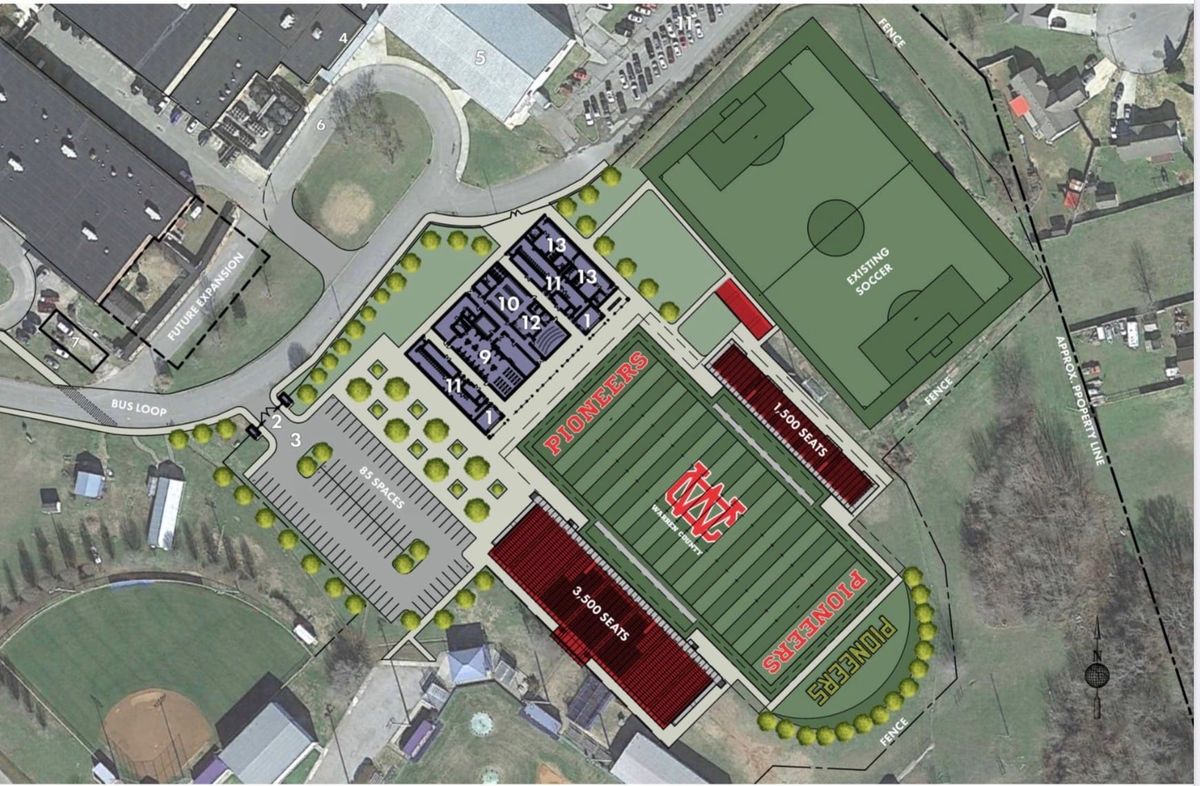
But when I look at what our kids need today, I believe having a stadium on our high school campus, along with a larger locker room, weight room and fieldhouse, would give our students something that fits the program we’re trying to build.
I’ve seen the renderings for what a potential new facility could look like. From what I’ve seen, it wouldn’t just be a cookie-cutter stadium.
There are ideas to pay homage to Nunley and the history of Warren County while creating something new for the next generation.
Ultimately, though, that’s a decision for the community.
What I want people to see is what our kids are doing every day.
They’re working hard. They’re showing up. They’re competing. They’re growing. They’re investing in one another.
And when a community invests in its kids, kids notice.
We’ve seen that with things like the new bleachers in the gym and the projection system. We’ve seen it with the effort that goes into homecoming.
Those things tell students that people care about where they are and what they’re doing.
I think our kids are hungry for that investment.
Whatever happens with the facilities, our job doesn’t change.
We’re going to show up every day and work.
We’re going to coach these kids. We’re going to hold them accountable. We’re going to celebrate them. We’re going to help them through the hard days.
If we had to play in a cow pasture, we’d still show up because that’s what these kids deserve from us.
The facility matters.
The resources matter.
The investment matters.
But at the end of the day, the kids are what matter most.