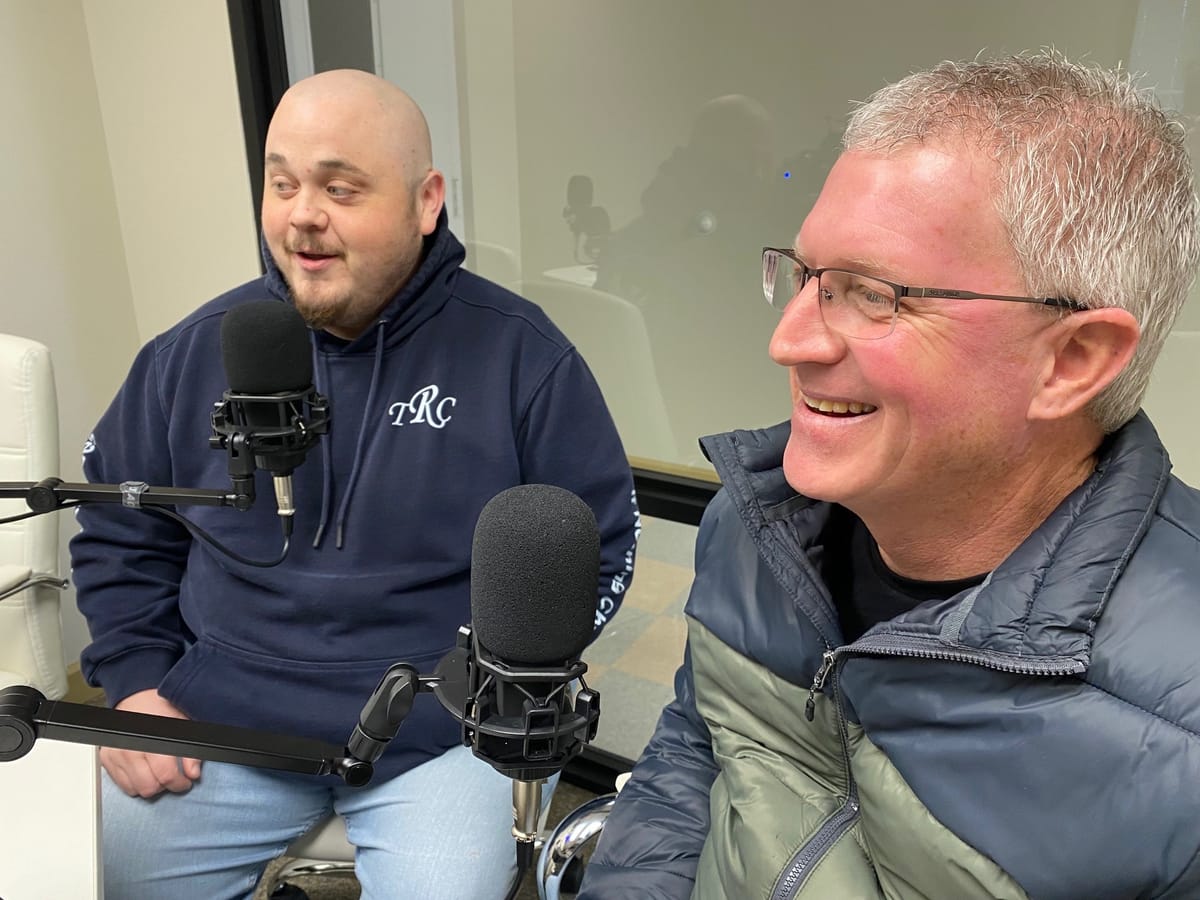
Bill Zechman photo - Sam Hillis, left, and Cory Hobbs visited WCPI’s Studio B to share their experiences and lessons from their struggle to overcome drug addiction and build new lives in sobriety. Their conversation airs Wednesday and Saturday at 9 a.m. both days.
The descent into drug abuse and addiction can start in different places and follow different paths.
Both men were raised in stable, respectable families. Both were regularly in church and rarely missed a day in school.
To the outside world, they both seemed to be fine. They were expected to grow into responsible, self-sufficient adults and “solid citizens.”
But on the inside, Sam Hillis and Cory Hobbs were sliding into substance abuse and hard addiction.
On their separate struggles to put drugs out of their lives, both found their Christian faith to be their lighthouse in the stormy seas of addiction.
“My faith (while incarcerated) in Warren County Jail cell 88,” Hillis said, “was exactly what I needed. I am forever grateful for the time I spent there.”
“When I had nowhere to look but up, I started reaching out to God. It wasn’t just jailhouse prayers,” he insisted in a WCPI INSIHTS recording set for broadcast this week.
“I had a lot of religion but not a lot of relationships,” Hillis said of his younger days in Sunday school and church.
“God will meet you where you are in your mess. I don’t have to be perfect for Him to love me. I have to be willing.”
Like Hillis, Hobbs had been in and out of jail for drug and alcohol offenses over a period of years.
“When I left Irving College School I went to town school,” Hobbs said of his difficult transition to Warren County High School.
“I wanted to fit in with everybody. My biggest problem was peer pressure.”
When high school graduation day came, “I was high when I walked across the stage” to collect the diploma. His drug of choice was methamphetamine, a synthetic drug that is often made in crude laboratories in or near the communities where they are sold.
“I didn’t know anything else but to try to get high.”
Hobbs added: “My mom brought me to church when I was a baby. I knew right from wrong.”
Reflecting on the collateral damage his drug abuse caused to family and loved ones, he offered ruefully, “The decisions we make have an effect not only on us but everybody else.”
Both Hobbs and Hillis credited their faith in God and the persistent love and support from their families with helping them turn their lives around.
Hobbs offered advice to family members and friends trying to help an addict overcome his or her demons. “Don’t ever give up on loved ones,” Hobbs pleads.
Hillis found professional, evidence-based help at the Tony Rice Recovery Center (www.TonyRice.Center), where he was once a successful client and now, living in sobriety, the clinical director.
“People can and do recover. Treatment does work,” he affirms.
One of the first steps toward recovery with support from family and community is the realization that “addiction is not a moral failure,” but a biological and behavioral issue that can be addressed with the proper medication and counseling.
For many decades in America, addiction was commonly viewed with disdain and contempt, pushing victims to the streets without any support. When drug problems cropped up in “respectable” families, the social and political response started to change.
“The ‘right kind’ of people started to be affected by it,” Hillis observed, with a broad reference to those in positions of political power and influence.
“The sons and daughters of important people, (and) politicians” started paying attention. “The white picket fence picture of success” was being shaken hard by the torments within the family.
“This affects everybody. Addiction doesn’t discriminate. Let’s get beyond the question of whether it’s a disease,” Hillis said. “The way to fight the stigma is we talk. We have genuine, person-to-person conversations.”
Hobbs emphasized that recovery is not a point in time. It’s a process that must be pursued day after day.
“I went to rehab and was clean for 15 years.” Then he got his second offense DUI charge in August 2018.
Confined to Warren County Jail, he recalled, “I slept for two weeks” on a thin mat on the floor of his cell “before I got up and realized what had happened.” After spending 75 days in jail, he was released but had nowhere to go but to his vehicle as substitute home.
“I prayed in my cell every single day to God to help me find a way. I learned a lot of hard, hard, hard lessons.”
Hillis pointed to a recently formed self-help group in McMinnville, the Warren County Prevention and Intervention Coalition. He suggests that those who want to know more about the program could view its Facebook page.
The weekly INSIGHTS conversation with Hobbs and Hillis airs Wednesday, Feb. 18, and again the following Saturday at 9 a.m. both days on McMinnville Public Radio 91.3-WCPI.
Share this article
The link has been copied!
Members Discussion
Your link has expired. Please request a new one.
Your link has expired. Please request a new one.
Your link has expired. Please request a new one.
Great! You've successfully signed up.
Great! You've successfully signed up.
Welcome back! You've successfully signed in.
Success! You now have access to additional content.