Sheriff's Office explains LPR camera decision
The White County Sheriff's Office says it ended its LPR camera program after an internal review, citing future privacy concerns and community feedback.


The White County Sheriff's Office says it ended its LPR camera program after an internal review, citing future privacy concerns and community feedback.
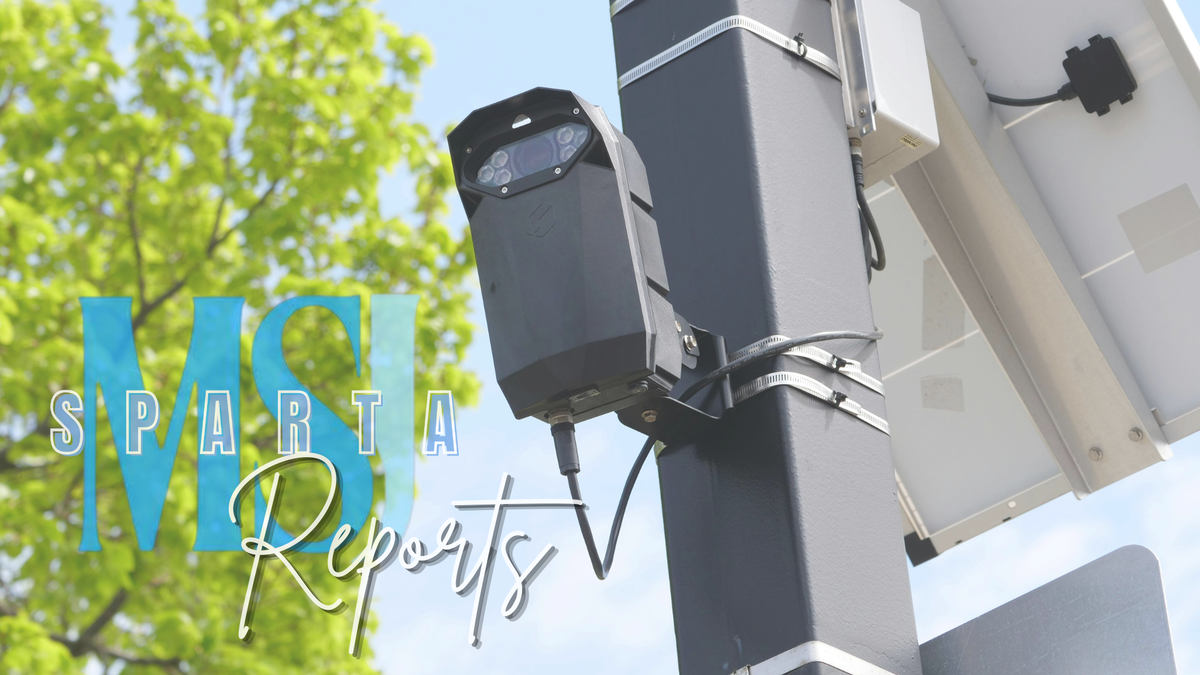
Update: White County Sheriff's Office officials say the department has already disabled access to its Flock Safety camera network, even though the cameras themselves have not yet been physically removed.
Following Tuesday's public announcement that the sheriff's office had independently decided to discontinue its license plate reader program, White County Commission Chairman Derrick Hutchings asked Captain Nate Theiss for clarification on the timeline and whether the system was still being used while awaiting removal.
Theiss said Flock Safety has confirmed the cameras are scheduled for removal but has not provided a specific date.
"They noted it should be soon, as they typically act quickly following a removal request. However, it appears their removal teams may be delayed due to the current national climate surrounding these systems."
Theiss also said the sheriff's office has effectively taken its camera network offline from a law enforcement standpoint, despite Flock not yet disabling the system on its end.
"I have disabled access on our end; therefore, all department users and other law enforcement agencies—statewide and nationwide—that we previously shared access with can no longer search or access our camera network," Theiss wrote. "It is not discoverable on the 'Share request map.'"
According to Theiss, the only accounts that remain active are two command staff accounts being maintained solely for administrative purposes during the cancellation process. He said those accounts "must be turned off on their end," referring to Flock, as the sheriff's office cannot deactivate them.
Until that occurs, the department continues to receive automated NCIC alerts through the Flock platform for wanted persons, missing persons, stolen vehicles and terrorist watchlists. However, with the county's camera network disabled from use by department personnel and outside law enforcement agencies, they are unable to use them for searches.
Theiss reiterated that the deactivation process was out of the department's control, but said that he would keep the county's commissioners informed as to when the cameras had been completely removed.
"I will let you know as soon as the network is officially offline and also when I'm told the last camera is removed. We appreciate your patience during this deactivation process."
Read the Main Street Journal - Sparta's original story, along with the announcement released by the White County Sheriff's Office on Tuesday, July 28, below.
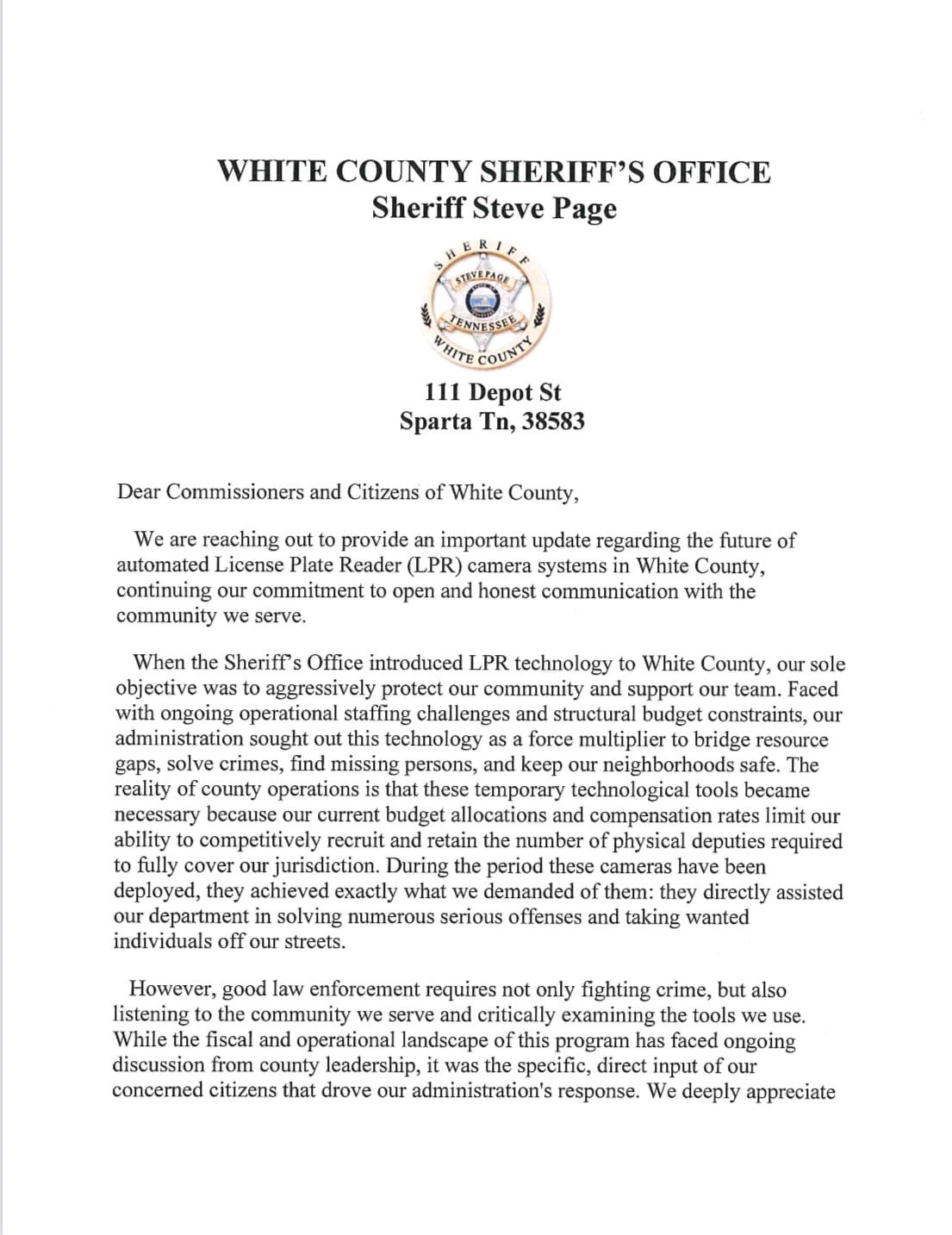
The White County Sheriff's Office announced Tuesday that it will not move forward with any additional automated License Plate Reader (LPR) cameras, saying the decision was made following an internal review and in response to concerns raised by local residents—not because of the White County Commission's recent vote rescinding the resolution that had authorized the technology.
In a letter addressed to county commissioners and residents, the department said the cameras had accomplished their intended purpose by helping deputies solve serious crimes, locate missing persons and apprehend wanted individuals during a time when staffing shortages and budget constraints limited the agency's ability to fully patrol the county.
"When the Sheriff's Office introduced LPR technology to White County, our sole objective was to aggressively protect our community and support our team," the letter states. "During the period these cameras have been deployed, they achieved exactly what we demanded of them: they directly assisted our department in solving numerous serious offenses and taking wanted individuals off our streets."
Despite that success, the sheriff's office said a deeper review of the technology's future led the department to change course.
The letter states that while officials continue to believe the systems are secure under current contracts, they became concerned about the long-term direction of third-party technology companies and the possibility that data could eventually be aggregated or monetized.
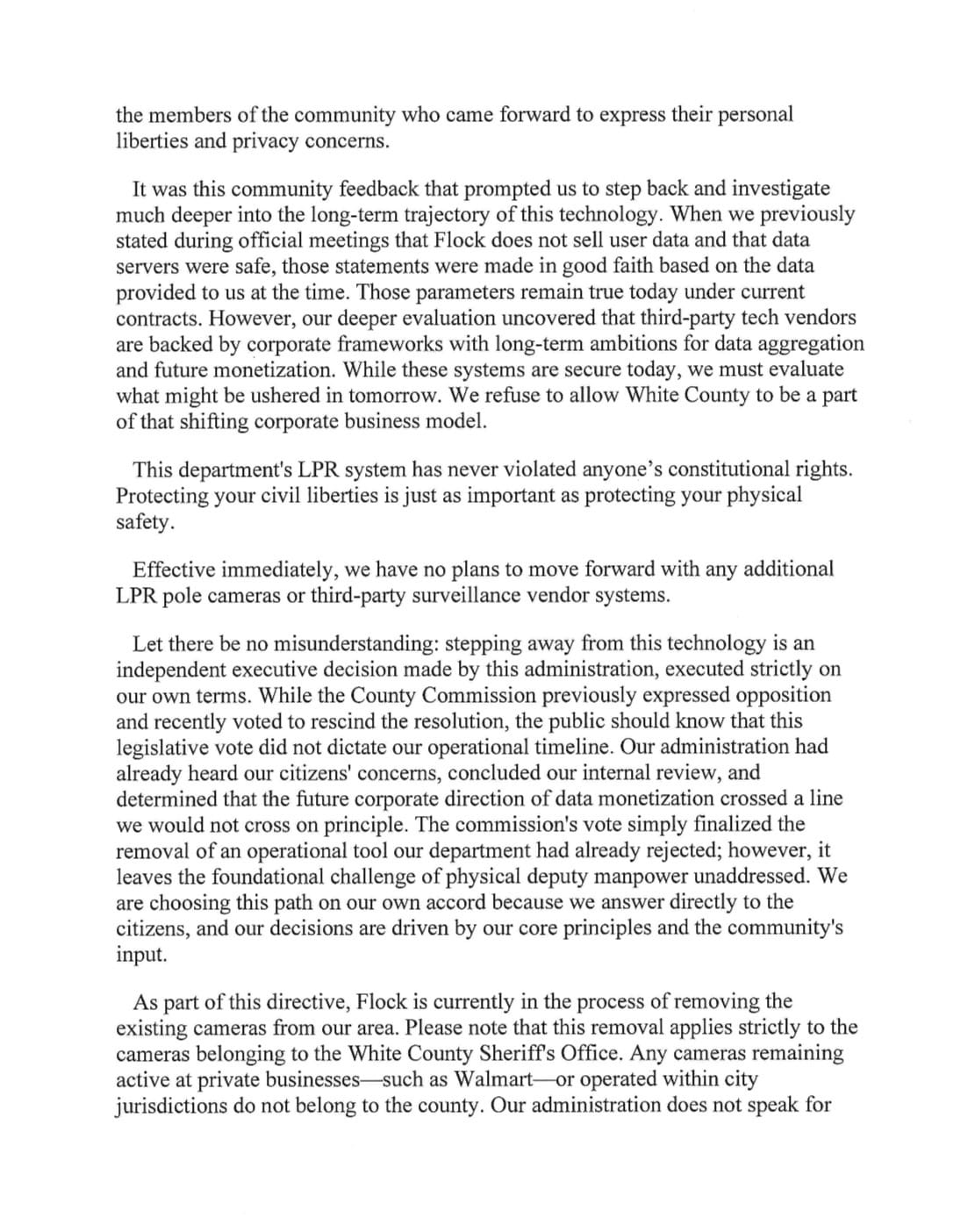
"Those parameters remain true today under current contracts," the letter states. "However, our deeper evaluation uncovered that third-party tech vendors are backed by corporate frameworks with long-term ambitions for data aggregation and future monetization. While these systems are secure today, we must evaluate what might be ushered in tomorrow. We refuse to allow White County to be a part of that shifting corporate business model."
The sheriff's office emphasized that its existing LPR program has not violated constitutional rights and said protecting residents' civil liberties is as important as protecting their physical safety.
Additionally, the department said it has no plans to install additional LPR pole cameras or expand the use of third-party surveillance vendor systems.
The letter also addresses the timing of the decision, stating that the sheriff's office had already begun moving away from the technology before county commissioners voted last week to rescind the resolution authorizing the program.
"Let there be no misunderstanding: stepping away from this technology is an independent executive decision made by this administration, executed strictly on our own terms," the letter states. "While the County Commission previously expressed opposition and recently voted to rescind the resolution, the public should know that this legislative vote did not dictate our operational timeline. Our administration had already heard our citizens' concerns, concluded our internal review, and determined that the future corporate direction of data monetization crossed a line we would not cross on principle."
According to the letter, the commission's vote "simply finalized the removal of an operational tool our department had already rejected," while leaving unresolved the underlying issue of limited deputy staffing.
The sheriff's office said Flock Safety is already in the process of removing the county-owned cameras. Officials noted that the directive applies only to cameras owned by the White County Sheriff's Office and does not affect privately owned cameras or those operated by municipalities such as Walmart and/or those operated inside Sparta city limits.
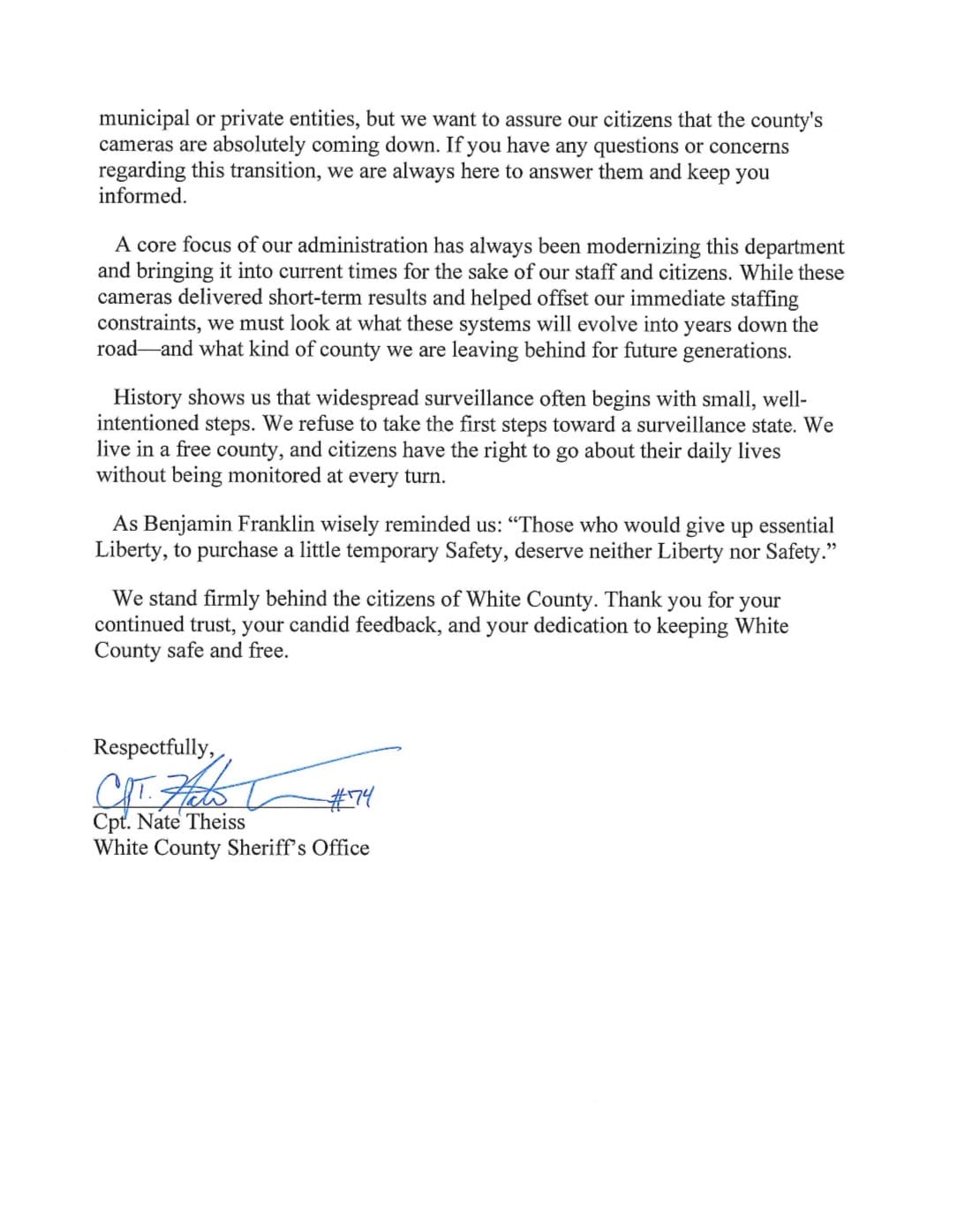
The department said it remains committed to balancing public safety with individual freedoms.
"While these cameras delivered short-term results and helped offset our immediate staffing constraints, we must look at what these systems will evolve into years down the road—and what kind of county we are leaving behind for future generations," the letter states. "We refuse to take the first steps toward a surveillance state."
Read the full letter below.